Municipal Dallas bulk sanitation services explicitly restrict building materials, excavation soils, and masonry waste exceeding standard bin weight thresholds. Property owners along residential corridors like Lakewood,…
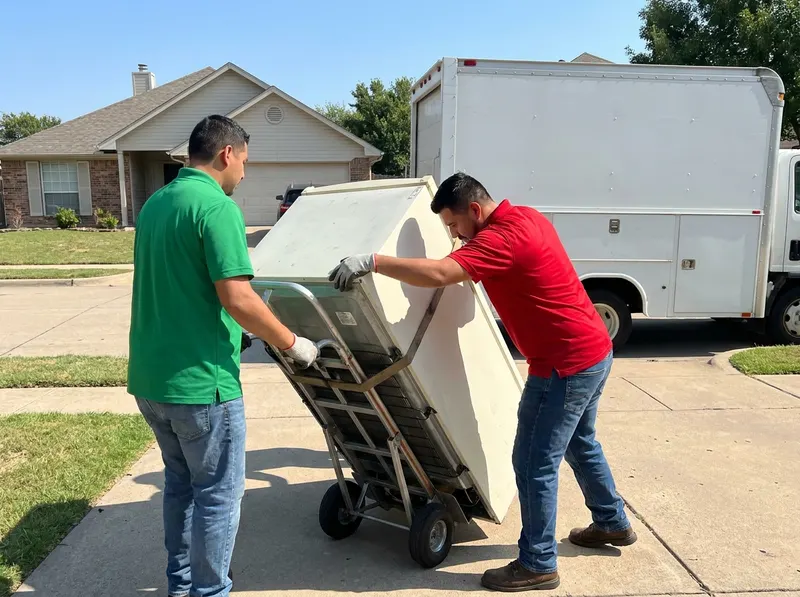
Municipal Dallas bulk sanitation services explicitly restrict building materials, excavation soils, and masonry waste exceeding standard bin weight thresholds. Property owners along residential corridors like Lakewood, Lower Greenville, and Lake Highlands frequently face steep code compliance fines when heavy remodel debris sits on street parkways past the designated monthly brush week. Hand-loading thousands of pounds of broken limestone or dense mortar carries high risks of physical strain and disc injury. Private heavy collection takes that physical burden off homeowners, clearing dense rubble immediately so driveways remain clear, safe, and free from pest-harboring debris piles.
Dense material transport demands strict axle-weight awareness and pavement protection. A single cubic yard of solid concrete weighs approximately 4,050 pounds, while a cubic yard of dry soil weighs roughly 2,200 pounds. Backing a commercial truck onto older aggregate or stamped concrete driveways in Preston Hollow, North Dallas, or Kessler Park without protective measures causes surface fractures and edge crumbling. Professional operators distribute gross vehicular weight across heavy timber runner mats before lifting begins, ensuring pristine driveway conditions throughout the entire extraction process. Unlike standard junk hauling that targets bulky lightweight furniture, heavy material collection utilizes specialized hydraulic lift gates, reinforced steel beds, and regulated transport routes avoiding weight-restricted residential parkways.
Selecting dedicated heavy material collection fits excavation and masonry projects where weight outpaces physical volume. For light household clutter or mixed interior drywall, standard bulk junk removal remains the economical choice. When handling broken foundation segments from an Oak Cliff bungalow renovation or unpainted brick retaining walls near the Bishop Arts District, heavy-load routing becomes essential to avoid mid-transit container rejection at transfer stations. The operational trade-off centers on load density versus volume: dense masonry fills hauling beds by tonnage long before reaching volumetric capacity limits, which requires targeted disposal manifests to comply with Dallas City Code Chapter 18 waste regulations. The work proceeds in three straightforward steps: 1. Dispatch arrives with protective driveway ground runners and heavy-duty staging equipment. 2. Operators hand-load or mechanically shovel dense stone, concrete, and soil directly into reinforced containers. 3. Trucks sweep the loading zone clean and transport materials directly to regional Dallas County aggregate recyclers or permitted landfills.
Every job gets a firm, written price after a free on-site visit.
Tell us about your special waste & heavy material collection job in Dallas and we'll send a clear, written quote, usually the same day.
 Maple Ridge Dumpster Rental